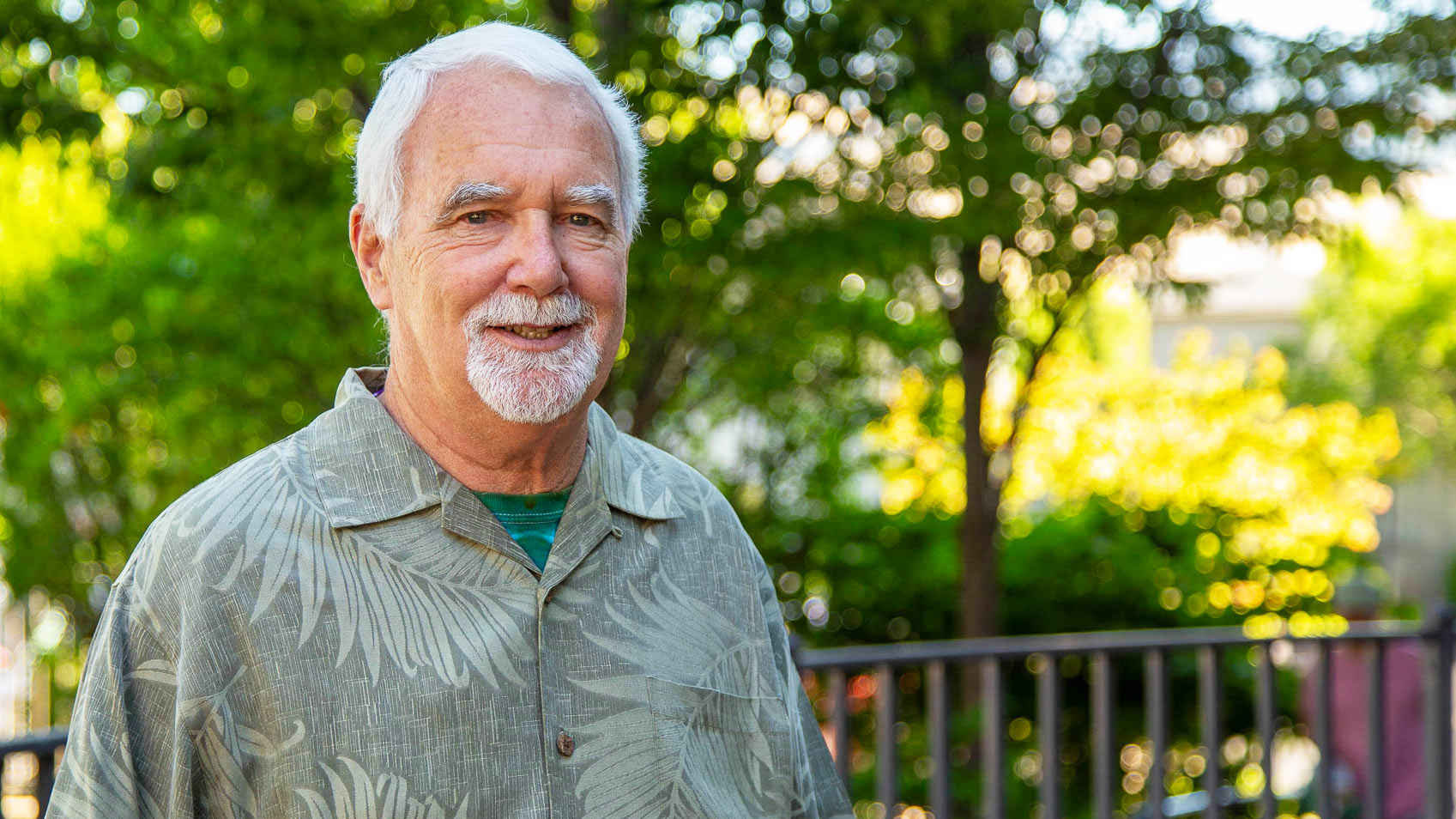
The Architect of Curiosity: David Eliasen Endows a New Gift to SOU’s Hannon Library
For many, a library is a building filled with books, but for David Eliasen, the Hannon Library is a repository for the world’s most fascinating arguments. A longtime Ashland resident and retired city employee, Eliasen recently established an endowment to ensure that the library continues to serve as a sanctuary for curiosity, much as it has for him throughout his life.
A Foundation Built on Service
Eliasen’s relationship with the Hannon Library began in the early 2000s, though he had been a friend of the library for years prior checking out materials long before joining the Friends of the Hannon Library Board of Directors. At the urging of friends, he joined the board just as the university was preparing for a major transition: the construction of the new library building.
During his six-year tenure, which included a term as board president, he was deeply involved in the build-out of the facility, witnessing the transformation from the old library to the modern building it is today. To Eliasen, the library is a vital resource for the broader community, noting that while sports often receive significant attention, “the library is an essential resource, and the community needs to be drawn in.”
Creating a Legacy
The decision to fund an endowment did not happen overnight. It was born from a mix of personal reflection and a few early morning epiphanies. After facing some personal and familial challenges, Eliasen began to think about his own legacy.
The turning point came during a conversation with a friend who shared that he had set up an endowment. Eliasen was surprised to learn that the price of entry for an endowment was more accessible than he imagined. This realization allowed him to move forward with a plan that divided his contribution into two parts: a personal endowment to the Hannon Library and a challenge gift to the Friends of the Hannon Library.
“I want my gift to go directly to the head librarian so they have the freedom to use whatever funds I can provide,” Eliasen explains. He intends for these discretionary funds to give library leadership the flexibility to address ever-shifting needs.
“If you’re thinking about your legacy and about doing something good in the community, this is a great place to start exactly because SOU is such a vital part of our community. It simply needs support, and I really encourage others to consider making a similar contribution.”
A Life of Wandering the Stacks
Eliasen’s passion for the library stems from a lifelong habit of using the library as a reward. During his undergraduate years at Western Oregon University, he would treat himself once or twice a term to an entire day spent in the library. He wandered the stacks and followed trails of information that led from the reference section to the far reaches of various collections.
One of his most memorable deep dives involved the Talmud, a massive collection of Jewish scholarship he discovered at SOU in the 1980s. Eliasen describes the Talmud as a “giant argument clinic” spanning 1,500 years, where rabbis debated everything from daily life to religious survival during the diaspora. “It’s just like a comedy routine in the sense that it’s like a giant argument,” he observes, marveling at the scholarship that allowed a culture to remain tied together through centuries of dispersal.
Preservation in the Digital Age
Eliasen’s gift is motivated by a concern for the future of information. In a world inundated with information and the looming complications of AI, David believes physical libraries and original sources are becoming more critical than ever. He worries about the vulnerability of purely digital repositories, noting that data centers are reliant on electricity and physical infrastructure that can be sabotaged or interrupted.
“Having things digitized at SOU allows the library to store a lot more information going forward,” he says. He views the library’s mission as a repository for information in its original form, providing a baseline for truth in a changing world. He specifically advocates for Special Collections, noting that these archives house unique items like the Shakespeare folios, which have the power to astound students who are used to digital screens.
Local History and Future Archives
David has a deep connection to Oregon history, some of which he has explored through the library’s map room. He recounts a story involving his great-grandfather, who homesteaded in the Lincoln Beach area in the 1890s. By examining original maps of the Siletz reservation, Eliasen was able to verify a family legend: that his great-grandfather had paid both the government and the Native American chief, Depoe Charlie, for his land.
The maps showed that the government had taken back a section of the reservation for homesteading, but his ancestor’s double payment reflected a pre-existing relationship and respect for the Native Americans who were still there. Looking forward, Eliasen is eager to see the library expand its Special Collections to include the personal stories behind local movements and businesses.
The Intersection of Skill and Service
Eliasen’s professional life also informs his appreciation for the library. He spent 20 years working for the City of Ashland in the water and electric departments. Later, he co-founded Organic Nation, a distillery where he applied his knowledge of water filtration to craft spirits. His experience as a small business owner gave him a profound appreciation for the creativity and hard work required to sustain an enterprise, a perspective he brings to his philanthropic work.
Eliasen emphasizes the importance of intellectual latitude. “My advice to future students is just to be curious and give yourself the freedom to explore while you’re here,” he says. He encourages students to use the resources available to broaden their horizons, recalling how an incredible geology professor at his own college motivated him to see how different pieces of knowledge fit together.
David Eliasen’s contribution to the Hannon Library is an investment in the curiosity of future generations. By supporting the library’s staff and collections, he is helping to maintain a space where, as he puts it, “the argument continues” across centuries, and where anyone with a question can find the original information they need to understand the world.
***
Read other inspiring donor stories in our annual report.